Quartz Crystal Microbalance with Dissipation: QCM-D – QSense Omni

QSense Omni gives you the sharpest QCM-D data and a smooth journey in the lab. Unfold unique insights into molecular interactions at surfaces and interfaces quicker, and base your decisions on reliable results from highly controlled measurements.

For Additional Information Request a Quote

Description

Let’s dive into the specifications of QSense Omni. You can also compare the data to other QSense instruments to find what you are looking for.

Measurement range and capacity

Measurement channels 1 – 4
Working temperature 4 to 70 °C
Sensors (frequency range) 5 MHz (1-72)
Number of measured harmonics 7, allows for full viscoelastic modeling

Sample and fluidics

 Volume above sensor     ~ 20 μl
Minimum sample volume ~ 90 μl
Flow rates Typical flow rate 20 μl/min. Flow speed range 1-200 μl/min

Performance characteristics

Maximum time resolution 300 data points per second (each data point represents an f and D value)
   LOD (3 x noise)    0.24 ng/cm2

See the graph below

Minimum noise Frequency: 0.0045 Hz
Mass: 0.08 ng/cm2
Dissipation: 1∙10-9
Long-term stability* Frequency: < 0.25 Hz/h
Dissipation: < 0.04.10-6 /h
Temperature: < 0.003˚C/h

All specifications are subject to change without prior notice

* The temperature stability depends on variations in how the ambient affects the warming or cooling of the chamber. The specified temperature stability may not be reached if the room temperature changes more than ± 1° C, due to draft or heat source for example.
Values taken after 1 h measurement with a QSX 303 SiO sensor in DI water at 25° C, Flow 20 μl/min and a data rate of 1 datapoint/s. Data interval used for analysis: 2 min. Even better stability can be achieved by waiting longer than 1 hour.  Weight excluding external power supply.

Optimal real-life performance

Applying a higher sample rate inevitably leads to higher noise and compromised limit of detection (LOD).
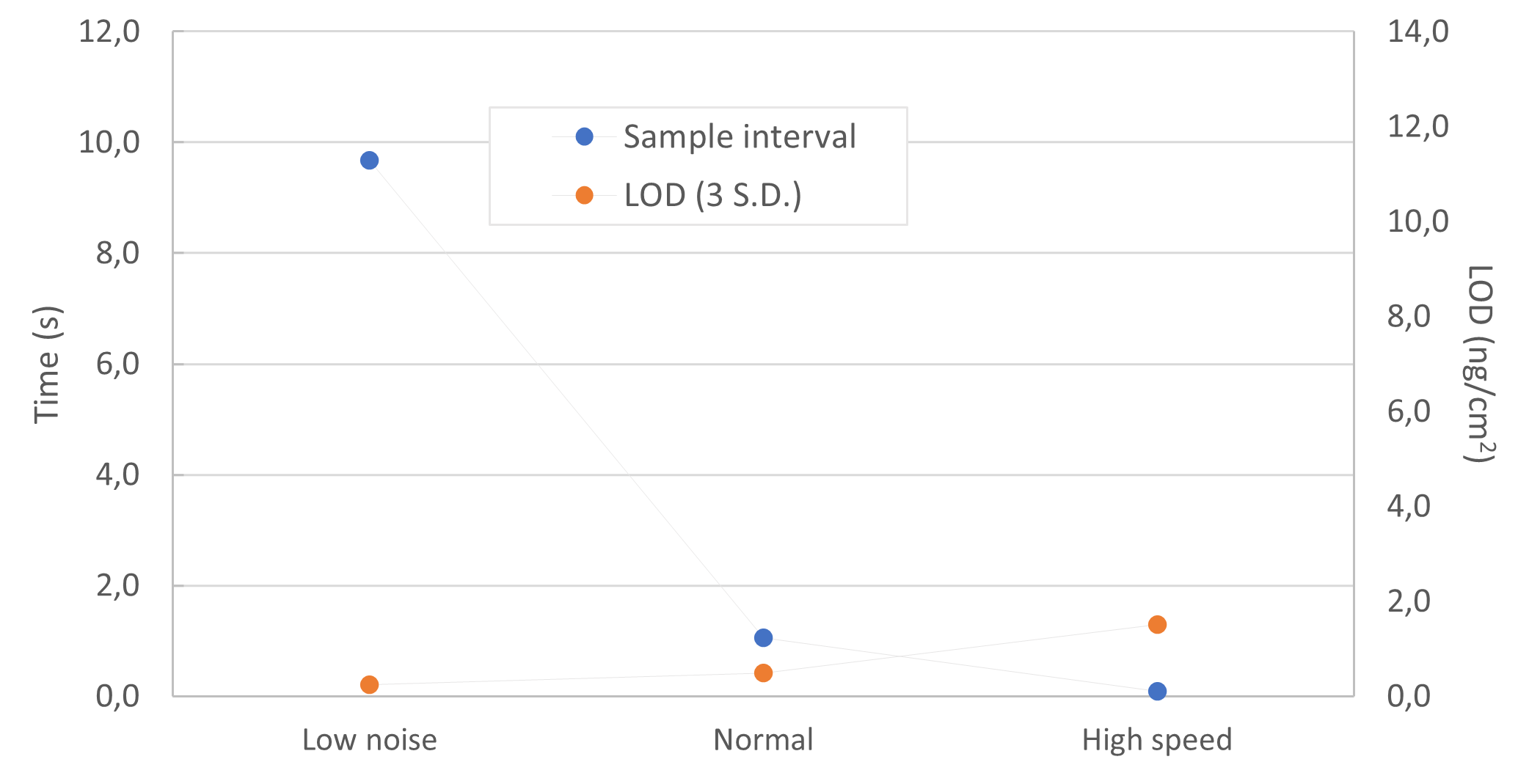
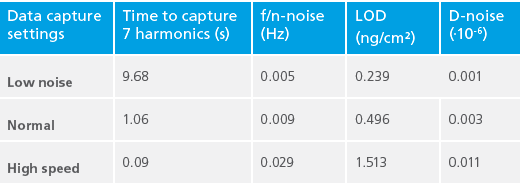
With significantly improved noise level, QSense Omni offers improved Limit of Detection. The figure and table below
describe the Limit of Detection of QSense Omni at three different sampling intervals, and demonstrates the low limit
of detection achieved also at high sample rates.

The below figure and table describe speed and limit of detection (LOD) per acquisition mode.
LOD updated by jennie cropped

Speed and limit of detection (LOD) per acquisition mode. Theoretical limit of Detection (LOD) at different sample intervals. Limit of detection is set to 3 times frequency noise level.
Data Capture

Performance characteristics. Measurements were performed with QSX 303 SiO sensors at 20°C temperature, and in deionized water at flow of 15μL/min, using one measurement channel. Each measurement mode was measured for approximately 5 minutes, and standard deviation of data points was collected within a set time range of 1 min to statistically determine noise data.